
Heather John
Photography: Jeremy Samuelson
March 14, 2004
Electric Company
Los Angeles-Based Designer Nony Tochterman of Petro Zillia Likes It Loud
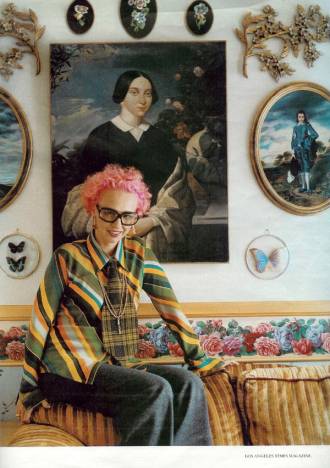 Nony Tochterman isn't afraid of color. But then you wouldn't be
if your hair was cotton candy pink. Or tangerine. Or fuchsia. The 37-year-old
Israeli designer and founder of Petro Zillia changes her look almost as often
as people change socks. "I like to reinvent myself," Tochterman says. "I like
to keep moving on. And I like to do that with clothes."
Nony Tochterman isn't afraid of color. But then you wouldn't be
if your hair was cotton candy pink. Or tangerine. Or fuchsia. The 37-year-old
Israeli designer and founder of Petro Zillia changes her look almost as often
as people change socks. "I like to reinvent myself," Tochterman says. "I like
to keep moving on. And I like to do that with clothes."
But keep in mind that Tochterman doesn't take herself too seriously. "I love
fashion, and I have an amazing passion for it," she says. "But it's only
fashion. We're not curing cancer here. Fashion is a luxury, so it's got to be
fun, something you can indulge yourself with, something that makes you happy."
Her designs have been compared with Missoni's, as both make lavish use of
multicolored knits. But the Petro Zillia label is more akin to a rebellious
teenage sister of the more mature Italian fashion house. Tochterman's pieces
might be hand-crocheted or loomed, patchworked or trimmed with dyed lace,
pompoms or ribbon. Layers of ruffles, psychedelic colors, vintage rickrack and
big buttons are regulars in the Petro Zillia lineup, which ranges from peasant
hippie to graphic mod depending on the season and whim. When designing,
Tochterman frequently experiments with Pantone color chips—grouping unexpected
combinations such as burgundy, melon and lilac, or mustard, orange and gray.
Tochterman's muse is an elusive creature. "She's an imaginary friend," the
designer says. As the program for Petro Zillia's spring 2004 fashion show
recounts, inspiration comes from the fictional Lulu Bratzzo, a sort of Forrest
Gump of fashion who "held the age of 29 captive" and guided friends Norma
Jean, Jackie O, David Bowie and Debbie Harry, among others, through Studio 54,
the Russian Tea Room and the California gubernatorial race.
For her fall 2004 collection, which debuts on March 29 during Los Angeles
Fashion Week, the designer has abandoned Lulu Bratzzo in favor of a feminized
Duke Ellington, and moved from the '60s, '70s and '80s to a jazz-era aesthetic
with a sort of Cotton Club meets the Electric Company vibe. Knit neckties with
stripes and metallics pair with feminine suits and silhouettes. "I'm really
into shirts and ties this season," she says. "But you can mix them up with
skirts and color to make it more girlie."
Tochterman founded Petro Zillia, which means parsley in Hebrew, in 1997 with
Yosi Drori, her husband and business partner of 16 years. But her foray into
fashion began as a child in Tel Aviv, where her mother owned a fashionable
boutique. She was 6 when the Yom Kippur War started and the army drafted her
father, so she and her mother stayed with a friend in Herzliya until it was
safe to return to Tel Aviv. "During those few days to keep me busy, my mom's
friend taught me how to knit," she says. "I've loved it ever since." She began
crafting clothes for dolls, and even made a few pieces to sell in her mother's
store.
At 14, Tochterman moved to Los Angeles with her family, and by 20 was living
in Manhattan, where she and Drori founded an accessories line called Nony New
York. The company manufactured clip-on button covers that—if you recall the
oversize buttons that were a late '80s craze—filled a market niche until the
trend died, and in 1995 the couple closed the company. "I know when to hold'em
and when to fold'em," she says. "We'd worked very hard and had been very
lucky, but we knew it was time to try something different."
About the time they closed the button cover business, Tochterman became
pregnant with their son, and the couple started thinking about ventures
outside New York. During a vacation in St. Martin, they found a hotel in need
of repair, made an offer and sold their Manhattan apartment. Two days before
closing escrow on the property, Hurricane Luis hit, devastating the island and
leaving Tochterman, Drori and their infant son, Etai, homeless. "We took that
as a sign," she says, and they headed for Los Angeles to stay with her
parents.
A Santa Monica bungalow, just blocks from the beach, caught their eye. It was
different from their gallery-like Manhattan loft and represented a fresh
start. "Everywhere you look you'll see a different detail or you see a
different color," Tochterman says of the house, though she could just as
easily be describing her fall collection. "Of course, the guy who painted our
house wanted to kill us." The house is an extension of Petro Zillia, with
animal-print carpets, patterned wallpaper, pop art, flea market finds and faux
fur furniture.
It's a tight-knit family, with Drori the "anchor" of the creative duo, their
son Etai, now 9, pursuing drawing at school, and daughter Romie, 5—whose
closet contains miniature Petro Zillia replicas—chiming in on what Mom should
wear. "I'm raising a fashion victim," the designer jokes. Even Tochterman's
father gets involved. "We ordered the zebra and leopard carpets for our home
and office from my dad, who's in the carpet business, and they arrived at his
warehouse a couple of weeks before they were ready to be installed," she says.
"His customers would ask, 'Who's the nut case who ordered these carpets?' He'd
say, 'I have no idea.' "
Despite her affection for her colorful, eclectic home and studio, even
Tochterman needs a break. "It's the best feeling," she says. "You get up in
the morning and go into a white bathroom, and it's like a clean slate. Then
you can start shifting through moods and colors and textures."
COPYRIGHT 2004 Los Angeles Times