
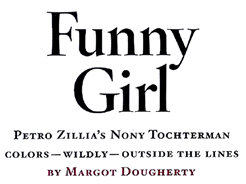
THE VAN NUYS WAREHOUSE OF PETRO ZILLIA, the ready-to-wear line designed by Nony Tochterman, opens with a curtain of Crayola-colored plastic beads interspersed with butterflies. Beyond is a conference room/wardrobe closet with a leopard-print rug and a pedestal table covered with a cloth of green petals limned in gold. Six high-backed bloodred velvet dining chairs surround it. A headless dress form shows off a Victorian wedding gown that's been dyed and reworked with ribbons and raffles, and a pair of gaily painted dressers serve as roomy plinths for displaying relics from Petro Zillia: The Early Years--the colorful crocheted handbags, knit scarves, and stretchy caps that launched the company in I997. Upstairs are the sewing and knitting machines, the library of vintage clothes, and the transparent containers of fabric scraps that will soon find themselves walking down a runway
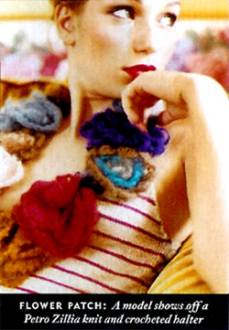
This decor is worth noting because it's a seamless extension of Nony Tochterman's approach to fashion. She's a girl's girl, and her line speaks to the choir with the swagger of a sassy coquette rather than the strut of a here-it-is hooker. It's Betsey Johnson without the trash, Missoni with less rigidity. The rods that run like a miniature train set around the room are hung with mismatched knits, wools, and silks in styles ranging from a gold halter top of die-cut leather circles to a wool-lined patchwork silk coat that's been washed to make it pucker. "The wool shrinks, the silk not so much," Tochterman points out cheerfully The overall impact of the line is of magpie whimsy and expert craftsmanship.
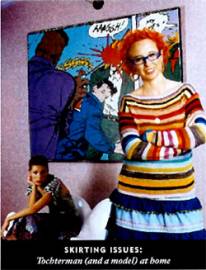
"I know when I wake up in the morning and put on something bright and colorful, it makes me happier," says Tochterman, who has tangerine hair, favors lime green sneaks, and greets the new day in a bedroom painted in horizontal stripes of yellows. She has been married to Yosi Drori, who is also her business partner, for 16 years; they have two children, Etai, 8, and Romie, 4. Tochterman's face is wide open, her smile is generous, and her demeanor contrasts with her sometimes goofy apparel. She's sound and logical, a soccer mom. She's so besotted with her daughter's ballet class that she finds herself with her face pressed up against the glass. "Life is short," she says. "You need to enjoy it. You never know what will happen tomorrow. We're not curing cancer here. It's got to be about fun and making people happy It's only fashion."
 TOCHTERMAN, WHO IS 37, was born into the
business. "My mom," she says, "had the hottest boutique in Tel Aviv and
was very fashionable. She'd go to Italy and Paris to buy material and
clothes for her store, and I'd tag along. I loved it." Nony (pronounced "Nonnie")
learned to knit at age seven during the Yom Kippur War, when she and her
mother were confined at her best friend's house. Soon she was making
clothes for her dolls. At nine, she rigged herself a halter top. "It was a
triangle of fabric and four strings," she says. "I was so proud." By 15,
she was selling her sweaters at her mother's shop.
TOCHTERMAN, WHO IS 37, was born into the
business. "My mom," she says, "had the hottest boutique in Tel Aviv and
was very fashionable. She'd go to Italy and Paris to buy material and
clothes for her store, and I'd tag along. I loved it." Nony (pronounced "Nonnie")
learned to knit at age seven during the Yom Kippur War, when she and her
mother were confined at her best friend's house. Soon she was making
clothes for her dolls. At nine, she rigged herself a halter top. "It was a
triangle of fabric and four strings," she says. "I was so proud." By 15,
she was selling her sweaters at her mother's shop.
"I knew ever since I was a little girl that I wanted to be in fashion," Tochterman says. "I didn't know if it would be in clothing or accessories or shoes, but I knew it would be in fashion." She moved with her parents to Los Angeles in 1980, when she was 14, then back to Tel Aviv a year and a half later to live with her grandmother. "I didn't get along well here socially," she says, "and academically; Israeli studies were a lot more advanced." En route to getting a master's in math in high school--"It's almost like college is here"--she debated with the principal about the irrationality of the uniform code. The outfits were so much improved, she argued, accessorized with a bandanna and belt. In her yearbook, one of her classmates wrote that Tochterman would grow up to be a fashion designer living in the United States. "Funny," Tochterman says now.
She returned to Los Angeles and joined her mother in her clothing business, based in the San Fernando Valley While working a trade show in New York the two had a heated argument. "To this day we have entirely different recollections of what happened," Tochterman laughs. The upshot was that she decided to move to New York and strike out on her own. At that same trade show she met Drori, a bartender with an artistic bent.
In their early twenties they started Nony New York, an accessories company that made clip-on button covers. "There were fabric bows, rhinestones, and metal designs," she says. "We had hundreds of styles." They started working from their bedroom and soon moved to a warehouse and had a staff of 60. "In the morning I'd look around and think, 'Oh my God, we're responsible for all these people's income and livelihood,'" says Tochterman. "We were the youngest ones there. Soon we were spending most of our day running a business rather than being creative. We kept thinking, 'The trend's going to end, we might as well maximize now.' Before we knew it, nine years had gone by" In 1995, they finally closed shop.
First they traveled. While on Saint Martin they decided to buy a small derelict hotel. They sold their New York apartment and completed the deal. Two days later the island was devastated by Hurricane Luis. "No airport, no electricity, no telephone, thousands of refugees," says Tochterman. "So. Change of plans." With no place to live and ten-month-old Etai in tow, they decided to crash with Tochterman's parents in L.A.
 THE TWO STARTED PETRO Zillia--Hebrew for
"parsley"--soon afterward. "Yosi thought it sounded like the name of a
person," Tochterman says. What began as a line of accessories evolved into
knits and clothing as Tochterman made a few sweaters and blouses and then
figured she'd "make some wovens so I could have some pants and skirts to
go with the tops. One thing led to another." In November 2001, Petro
Zillia got a last-minute spot in an Audi-sponsored group fashion show. "It
was two weeks of intensely going crazy," Tochterman says. "All of our
friends, all of our interns, my brother, my cousin--we all worked around
the clock." A week before the show, they realized they'd forgotten to get
the shoes. They raced downtown to Santee Alley, bought cheap sandals, and
embellished them with beads, Swarovski crystals, and in the case of one
unforgettable pair, hot pink raffia. They glowed in the dark. The show got
mixed reviews. "Some people," Tochterman says, "thought we had taken it
too far."
THE TWO STARTED PETRO Zillia--Hebrew for
"parsley"--soon afterward. "Yosi thought it sounded like the name of a
person," Tochterman says. What began as a line of accessories evolved into
knits and clothing as Tochterman made a few sweaters and blouses and then
figured she'd "make some wovens so I could have some pants and skirts to
go with the tops. One thing led to another." In November 2001, Petro
Zillia got a last-minute spot in an Audi-sponsored group fashion show. "It
was two weeks of intensely going crazy," Tochterman says. "All of our
friends, all of our interns, my brother, my cousin--we all worked around
the clock." A week before the show, they realized they'd forgotten to get
the shoes. They raced downtown to Santee Alley, bought cheap sandals, and
embellished them with beads, Swarovski crystals, and in the case of one
unforgettable pair, hot pink raffia. They glowed in the dark. The show got
mixed reviews. "Some people," Tochterman says, "thought we had taken it
too far."
Drori was part of the sandal detail. It doesn't take long to see that he, also from Israel, and Tochterman are separate but equal in terms of creativity. She collects and recycles fabrics; he finds furniture and artwork in unlikely places (the Salvation Army is a mother lode) and restores or reinvents them. She can't grow a cactus; he's created a Provencal garden in their Santa Monica yard. It was Drori who scored the vintage wallpaper used throughout their house and he who dyed it pink in the room they used as an office until they discovered they were expecting Romie. Their talents merge in the Petro Zillia collection. Last year Drori found a collection of miniature prewar Japanese-made porcelain dolls, each dressed in a costume representing a different country They became the theme for the spring collection, a contemporized celebration of lace-up corsets (Ms. Italy), layers of ruffles (Ms. Spain), and slip minis with tribal icons (Ms. Native America). For spring 2004 Tochterman is extrapolating the looks from The Practical Encyclopedia of Good Decorating and Home Improvement, published in the '70s. Drori found the books on eBay "I look at the wallpaper," says Tochterman, flipping through the pages, "and I see fabrics."
For this fall's line, inspiration came from old movies. "Yosi and I got into watching classics," she says. "We got totally obsessed with films like On the Waterfront and Breakfast at Tiffany's." The '50s influence is readily apparent in her latest creations: velvet vests, knickers with gold watch fobs looped from waistband to pocket, pin-striped three-piece suits, circle skirts, fedoras, and newsboy caps. "I'm inspired by vintage and the past, but I don't want to be too literal," Tochterman says. "I want to put my own signature on it." To wit: The vests, purple or orange, are fitted over wildly patterned satin shirts; the knickers have mini mid-thigh pockets and satin ribbons; the pinstripes have baby blue and pink velvet piping; and the circle skirts are painted with a few melodic flourishes affixed with clusters of pink tulle--voila, a 3-D rose vine. The "aha" moment at the Mercedes-Benz fashion show, which was part of Los Angeles fashion week in April, came with a madcap skirt made of gathered discs of fabric that gave the impression of crushed versions of the newsboy caps. The skirt floated back and forth on the model like a church bell.
This time Tochterman had help in the shoe department. Dana McCarthy, a New York-based designer at Steve Madden, worked with Tochterman on the footwear for the show. The two collaborated via fax and phone. "Usually designers are very, very particular," McCarthy says. "Nony gives you an open window to play with. She would send black-and-white sketches and her storyboards--beautiful clippings of fabric and trim--as well as magazine pictures of shoes she thought might work. She has such a kinetic energy and positive outlook. I felt like she was in the same room." McCarthy suggested this, Tochterman suggested that, ideas began to mesh, and the outcome was a group of platform sandals with peekaboo toes--recently shot for Italian Vogue--and stiletto heels with exaggerated bows at a rakish tilt. Theywere '50s femininity on steroids.
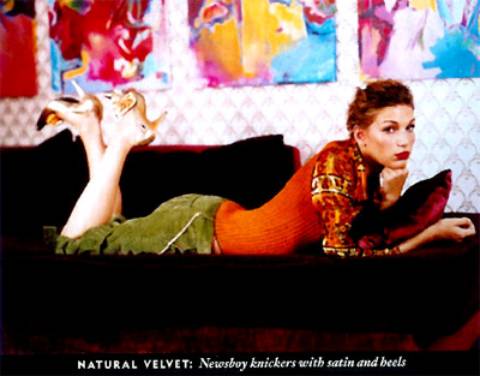
"Yes, maybe sometimes I take it too far," Tochterman concedes, her large gold shell earrings from the Slauson swap meet swaying as she laughs. She's at home now, sitting on the purple velvet couch in her living room. "I realize that not everyone would put on as many colors or put themselves together as I would, but that's okay They don't have to wear a whole outfit. They can just wear a T-shirt or a skirt or pants." Or a velvet Audrey Hepburn dress or a silk skirt with a mantilla lace overlay
It's no wonder that the Petro Zillia show, which was a highlight of fashion week, was SRO. Tochterman's message may be outre, but it comes with a giant wink and appeals to the likes of Paula Abdul, Mary J. Blige, Zooey Deschanel, Hillary Duff, Daryl Hannah, and Britney Spears, all of whom worked with Tochterman to create one-offs. Perry Farrell of Jane's Addiction recently ordered her gold hot pants. A wispy gown and coordinated sweater that Tochterman made for Hannah is now in the collection of the Pasadena Museum of California Art. Made of Italian wool, the floor-length sweater is a tour de force of knitwear, with yarns looping and curling one on top of the other like a litter of puppies. The collar and swaths of the hem are so luxurious, they look like the unruly fur of a rare and cloven-hoofed high-altitude species. "I'll never make another one like that," Tochterman says. "At the show, my friend [L.A. designer] Cornell Collin asked me what I'd take for it, hypothetically--$5,000? $10,000? I said, 'Nothing. Not for sale. It took forever.'"
Senior editor Margot Dougherty ("Funny Girl," page 50) covers travel, home, food, and style for Los Angeles. She formerly worked at Life, People, and Entertainment Weekly and was a founding editor of Who, the Australian counterpart of People.
COPYRIGHT 2003 Los Angeles Magazine, Inc.
COPYRIGHT 2003 Gale Group